
Over the five years to January 2026, Hagerty UK’s price guide had the Toyota Supra A80 up 41.8%. Over the same five years, it had the Vauxhall Viva HC down 23.2%. Both are classics.
“Classic” describes the car. Even the government’s definition is about age: a car built before 1 January 1986 can stop paying vehicle tax from 1 April 2026, under GOV.UK’s historic vehicle rules. The label says nothing about which way its price is heading, and the figure on the insurance documents is a different number from the one a buyer would pay. Those two points settle most of what classic car value means for a net worth sheet.
The general method in how to value a collection applies here: recent comparable sales, net of selling costs. Classic cars add complications of their own.
Classic values move both ways
The movements above come from a list Hagerty UK published in January 2026, with values “correct as at 11 January 2026” and drawn from its own price guide.
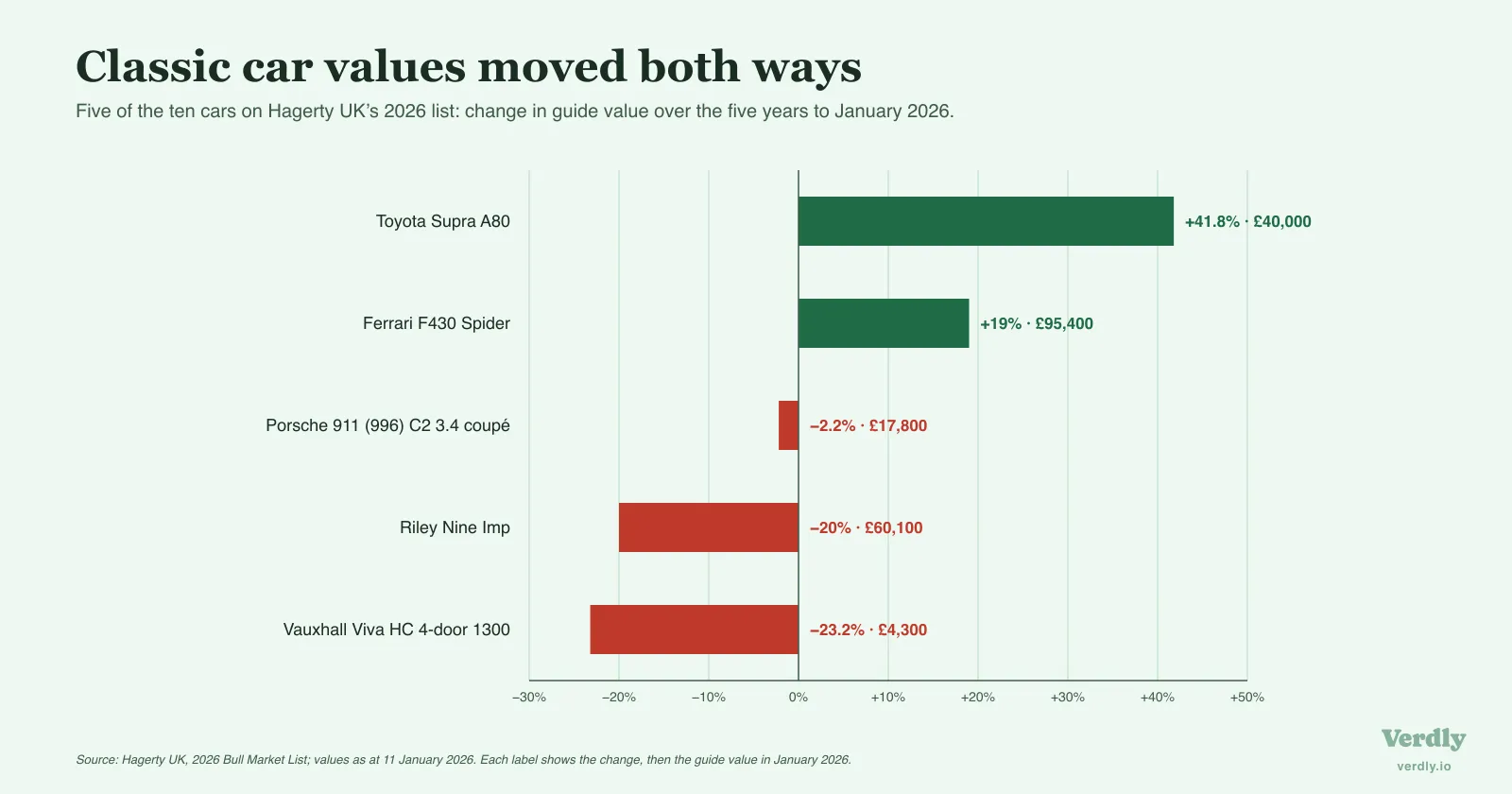
Source: Hagerty UK, 2026 Bull Market List, values as at 11 January 2026. Where the list names a grade, the figure is Hagerty’s “excellent” (#2) value.
These are five of the ten cars on Hagerty UK’s 2026 list, chosen here to include its biggest riser and biggest faller. They show how far apart values in one guide can move by the same date. The same article notes that values of pre-war cars “have dropped significantly in recent years”. Hagerty launched its Classic Index in December 2015 to monitor “the values of 50 classic car models”, with values taken from its price guide, which is updated quarterly. An index like that tracks a basket of models, which shows the direction of a segment; the value of one car still comes from sales of that car.
Where an ordinary car loses value year after year, a classic can go either way. Each revaluation starts from fresh sales evidence.
Which condition grade the car is really in
Hagerty’s price guide gives each model four values by condition: Concours (#1), Excellent (#2), Good (#3) and Fair (#4). The figures come from classic car auctions, dealers, private sale prices reported by its insured clients and values on UK classic car websites.
Hagerty’s own guide to the grades is blunt about where most cars sit. A true #1 is “almost never seen outside of major concours events”. A #2 “constitutes the majority of fully restored vehicles”. And “the vast majority of collector cars are in #3 condition”.
A #3 car matched against #2 sales comes out overstated by the gap between the grades. The grade is the comparable.
Agreed value vs market value
A classic’s policy can carry two numbers, and the Financial Ombudsman Service’s guidance on motor valuations and write-offs describes both.
Market value, in the ombudsman’s terms, is “the price the vehicle would have sold for at a reputable dealership”, just before it was damaged or stolen. That’s a retail price, the figure on a dealer’s forecourt. The same guidance notes that the standard valuation guides don’t cover older vehicles, usually those over 20 years old, so other evidence such as engineers’ reports is used instead.
An agreed value is an amount fixed when the policy starts, which the insurer pays if the car is written off. The ombudsman describes these policies as uncommon and generally used for valuable or classic vehicles.
Verdly publishes for education, not financial advice. Your circumstances will differ, so speak to a regulated adviser for decisions specific to you.
Neither number is the private-sale figure a balance sheet uses. The insurance market value is retail. An agreed value stays put while the market moves: if values have fallen since it was set, it sits above today’s sale price, and if they’ve risen, below. The wider gap between insured value and market value applies to any collectible. The agreed value is the motor version of it.
What an agreed value is made of
In one case the ombudsman decided in 2024, an owner insured two classic cars he valued at £60,000 and £50,000. The firm arranging the cover set an agreed value of £25,000 for each, then offered £30,000, working from a buyer’s guide that gave a range of £20,000 to £30,000 for the same make, model and engine size. The owner said a previous insurer had agreed £45,000 for each car.
The same two cars carried three sets of figures, each built from different evidence. The ombudsman said “it’s not the role of this service to put an exact Agreed Value on a car”, said it couldn’t call the firm’s approach unreasonable, and saw a signed independent valuation from a member of the Institute of Automotive Engineers and Assessors as a fair route to a review.
It’s one anonymised decision, not a rule. What it shows is how an agreed value gets made: guides, adverts, photographs and condition, put through a negotiation in which each side brings its own evidence.
What restoration spend buys
One of the two cars in that case had cost over £45,000 to restore from a bare shell. The firm’s position was that a restored car “is generally never valued close to how much an owner has spent”, and the decision left that position standing.
The price comes from sales of comparable cars in the same grade, whatever the receipts for the work add up to. On the tax side, capital gains tax treats cars differently from most collectibles: a car not used for business is exempt.
Putting it on the sheet
The net worth line is today’s realistic private-sale figure: recent sales of the same model in the same grade, less auction commission or fees. The agreed value is a separate fact about the car, with a date attached.
In a net worth tracker that keeps a note beside each value, the private-sale figure is the holding’s value, and the agreed value and the date it was set go into a note on each snapshot alongside the sales used. Fresh evidence arrives with auction results and guide updates, which shapes how often a figure like this needs revisiting. It takes a few minutes to give the car its own line.
Over five years the Supra and the Viva went in opposite directions. A dated sale figure, with its evidence written beside it, is the number that shows which way each one went.