
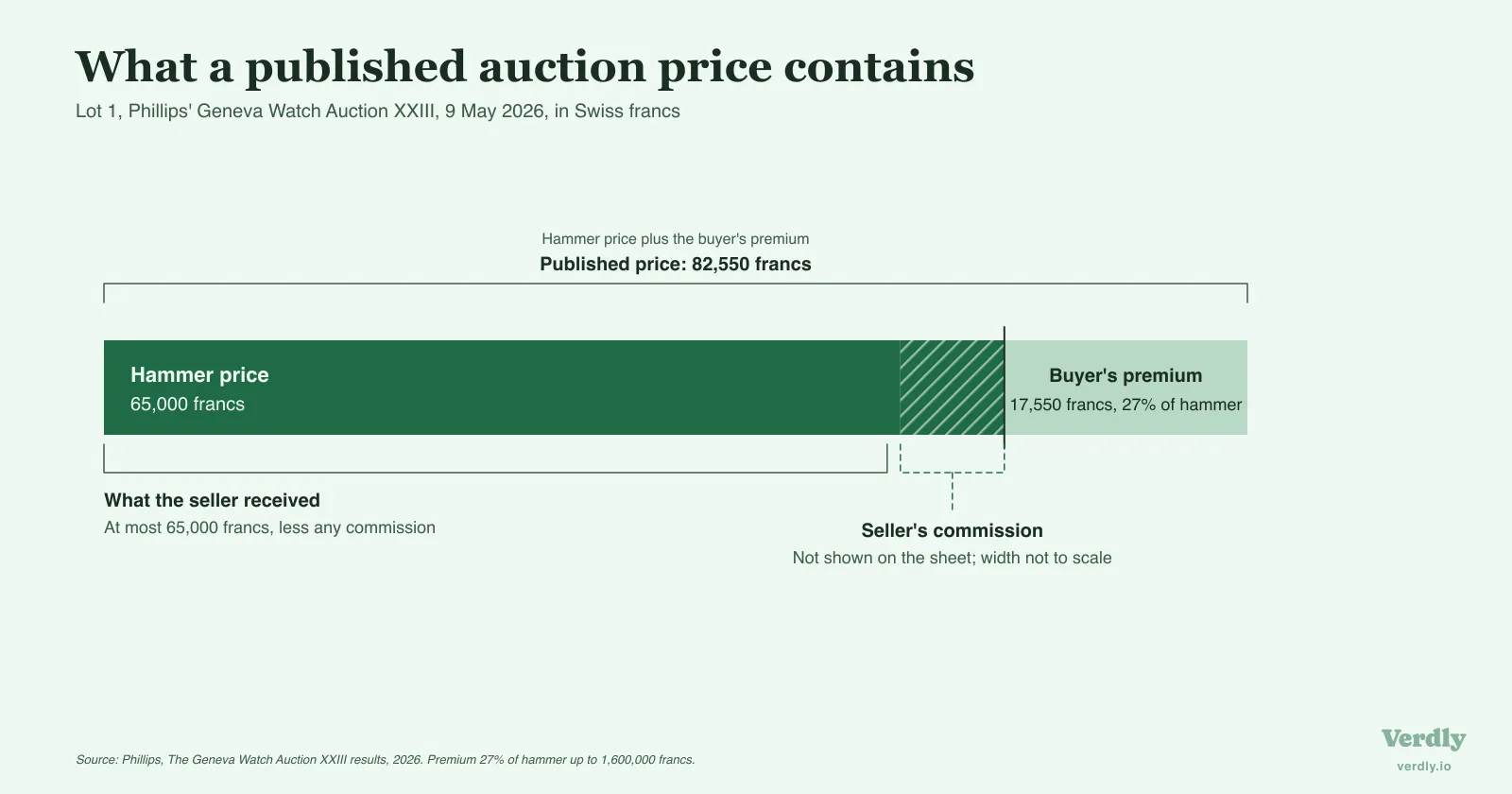
Lot 1 at Phillips’ Geneva watch sale on 9 May 2026 is listed at 82,550 Swiss francs. Whoever consigned it received 65,000 at most.
Nothing went missing. The listed figure is the hammer price plus the buyer’s premium, and almost every price a watch leaves in public is a buyer’s figure: auction results, marketplace listings, index charts. A net worth needs the seller’s side. So let’s work through how to value a watch by reading each kind of evidence for what it records.
The general method, recent sales of the same thing, is set out in valuing a collection. Here we apply it to one watch.
Pin down the same watch
Watches make matching easier than most collectibles, because each carries a reference number: the maker’s code for one exact version of a model, where the model name alone can cover several. Three things decide whether another sale counts as evidence for yours:
- The reference number.
- Condition, including wear, replaced parts and service history.
- Box and papers, meaning whether the original box and paperwork are present.
A sale that differs on any of them is weaker evidence. A handful of close matches tells you more than one striking result for a near miss.
Where matching sales turn up
Most watches never go near a Geneva saleroom. For an everyday reference, eBay’s completed listings are a public record of what buyers paid, though its product research help page says they include only listings sold “in the previous 90 days”. Product research, eBay’s tool for sellers, reaches back three years and shows the price paid even where a Best Offer was accepted.
Auction houses publish the rest. Phillips lists its past auctions by department, watches among them, and Bonhams prints a price beside each sold lot on its sale pages. Both come with the buyer’s premium inside.
Dealer and listing sites mostly show asking prices, which record what a seller hopes for until something sells.
Take the premium out of an auction price
Phillips publishes each sale’s results as a single sheet. The results for The Geneva Watch Auction XXIII begin: “The following prices in Swiss Francs include the buyer’s premium and are rounded to the nearest franc.” For that sale, the premium was 27% of the hammer price up to 1,600,000 francs, with lower rates above.
So a published price below that threshold is the hammer price plus 27%. Dividing by 1.27 gets back to the hammer:
- Published price: 82,550 francs
- Hammer price: 82,550 ÷ 1.27 = 65,000 francs
- Buyer’s premium: 17,550 francs, about a fifth of the published figure
The hammer price is the ceiling on what the seller received. Sellers pay the auction house a commission of their own, and the sheet doesn’t print it.
The terms are set sale by sale. At the equivalent auction in May 2025, the 27% band stopped at 1,000,000 francs.
London results carry the same convention in pounds. Bonhams’ online Weekly: Watches sale, which ran from 21 November to 3 December 2025, labels each result as sold for a sterling amount “inc. premium”, and its terms add VAT at 20% on that premium.
Verdly publishes for education, not financial advice. Your circumstances will differ, so speak to a regulated adviser for decisions specific to you.
Count the lots that aren’t there
The Phillips sheet carries a second line worth reading: “Lots which did not sell or have been withdrawn do not appear below.” Its numbering runs to lot 229 and it lists 224 lots. It doesn’t say which of the missing five went unsold and which were withdrawn.
Search an archive of results for your reference and that rule applies to every sale in it. Each price belongs to a watch that found a buyer, so a run of strong results is partly a record of which watches sold.
Convert at the sale date
Geneva sells in francs. The Bank of England publishes a daily spot rate for the Swiss franc into sterling, and on 8 May 2026, the last business day before that Saturday sale, it stood at 1.0592 francs to the pound.
| Lot 1, 9 May 2026 | Swiss francs | Pounds at 1.0592 |
|---|---|---|
| Published price, premium included | 82,550 | £77,936 |
| Hammer price | 65,000 | £61,367 |
That leaves a choice about how the watch enters a net worth, and both versions hold together. One converts the evidence once, at the sale-date rate, and records the watch in pounds. The other records it as a holding in another currency, which Verdly converts at the European Central Bank reference rate for each snapshot’s date, so its sterling value moves with the franc between revaluations. A holding’s currency is fixed from its first snapshot, which makes this a decision for the day it’s set up.
Marketplace prices
eBay UK, as one example of a marketplace, says private sellers pay no transaction fees outside the vehicles category, while buyers pay a Buyer Protection fee that’s “already included in the item price”. In eBay’s own example, a £500 item shows as £516.70 plus postage. The seller’s figure is the £500.
What an index measures
Watch indices, such as the WatchCharts Overall Market that Knight Frank reports in its Wealth Report 2026, follow the market as a whole. One reference in one condition can move apart from that, so an index is a reading of the market around your watch.
Write the figure and its evidence down
Each watch worth tracking gets its own holding. The figure closest to what a seller would receive is the hammer price of the best recent match, converted at the sale-date rate, less a seller’s commission where there’s a known figure for one.
Verdly is a net worth tracker with a field for the source: the note on each snapshot, which can hold the sale, the lot number, the hammer price and the exchange rate behind that date’s figures. It’s what makes the number repeatable next year by someone who has forgotten how they reached it.
The figure moves when new matching sales appear, on the market’s timetable. However often you check your net worth, the same figure carries forward in between. Setting a watch up takes one holding and a first note in Verdly.
Selling is a separate question. Gov.uk’s limited lifespan guidance treats watches as machinery and exempts them from Capital Gains Tax, with an exception for business use, and how a watch sale is taxed covers the detail.
Worked back to 65,000 francs, converted at 1.0592 and noted against the date, lot 1 becomes a figure anyone could check. That’s the standard a watch on a balance sheet can meet.