


Almost every line on a net worth sheet arrives with someone else’s number attached. The bank sends a balance, the pension provider sends a statement, the broker prices the fund every evening. A watch in a drawer, a binder of graded cards, a shelf of first editions: nobody sends anything for those.
So the figure for a collection is one you build yourself. Let’s work through how to value collectibles in a way that would survive someone asking where the number came from.
Nobody sends a statement
Even official statistics take the owner’s word here. The ONS counts antiques, artworks and collections as part of household physical wealth, and its quality and methods guide describes that measure as a self-valuation, with some items collected in value bands. That’s in the Wealth and Assets Survey for April 2020 to March 2022, whose official accreditation is currently suspended.
A house at least has an index for its area. A collection has nothing comparable, which makes it the clearest case of the point in exact, reported and estimated figures: an estimate is really the name of the method behind it. The useful question is which method.
The standard to aim at
HMRC has a definition worth borrowing. Its manual says the market value of an asset is “the price which that asset might reasonably be expected to fetch on a sale in the open market”. It comes from tax law, and it’s also the clearest statement of what a balance sheet figure is meant to be.
It’s the same rule applied to a car, and it rules a lot out. The open market is other people, today, with their own money.
Verdly publishes for education, not financial advice. Your circumstances will differ, so speak to a regulated adviser for decisions specific to you.
Four numbers, ranked
Most people reach for one of four figures. They measure different things.
| Figure | What it measures | Fit with the standard |
|---|---|---|
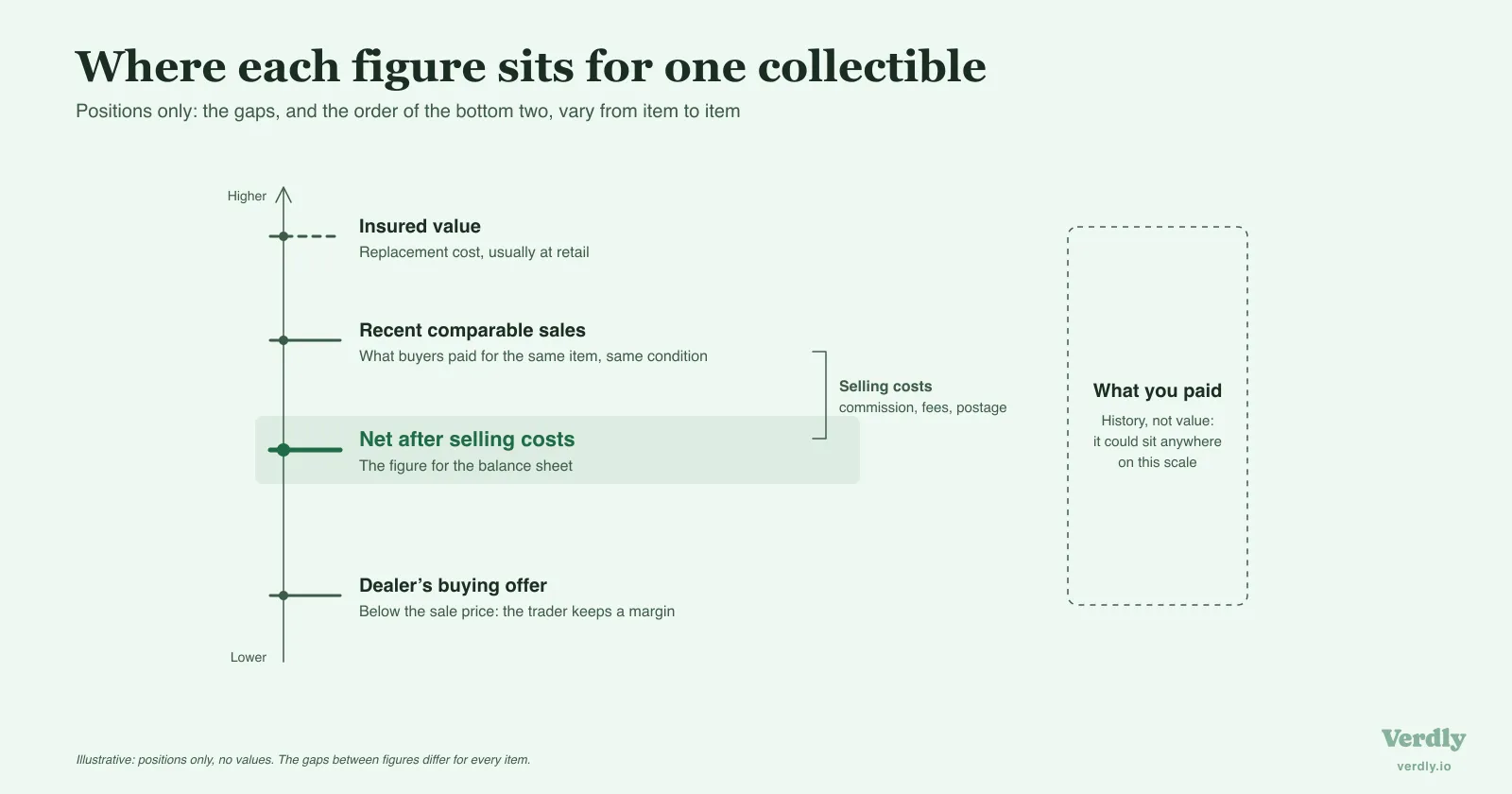
| Recent comparable sales | What buyers actually paid for the same thing | Best |
| A dealer’s buying offer | What a trader will pay and still make a margin | A floor |
| What you paid | The market on the day you bought | History only |
| Insured value | What it would cost to replace | Runs high by design |
Recent comparable sales are the closest thing a collection has to a price. The match has to be tight: the same reference or edition, the same condition or grade, and completed sales rather than asking prices, because a listing only tells you what a seller hopes for. Several recent results beat one. Where an item rarely trades, the evidence is thin, and the figure deserves less confidence than one backed by a dozen sales.
A dealer’s buying offer is real money, but a dealer has to resell at a profit, so the offer sits below what the item would fetch from a private buyer. It’s a useful lower bound.
What you paid describes the market on the day you bought. It’s still worth keeping, because it’s the number how a sale of one is taxed starts from.
Insured value is a replacement cost: what it would take to buy an equivalent item, usually at retail. It’s there to make sure a claim covers a replacement, so it sits above what you’d get selling. It belongs on the insurance schedule.
Take the selling costs off
What lands in your account is less than the sale price. Auction houses charge sellers commission, marketplaces take fees, and an expensive item may need insured postage, authentication or grading before anyone will pay full price for it.
HMRC’s definition is a gross sale price. A balance sheet is better served by the net figure, after those costs. If the comparable sales are auction results, the seller of each one received less than the figure published, once commission came off.
The owner’s estimate runs high
The figure most likely to drift is the one in your own head. Behavioural economists call it the endowment effect. In experiments by Kahneman, Knetsch and Thaler, people randomly handed a coffee mug asked far more to part with it than people without one would pay for the same mug. In the paper’s words, willingness to accept “greatly exceed[s]” willingness to pay.
The effect is contested. Plott and Zeiler changed how valuations were asked for and found no gap at all. Whatever the cause, the practical check is the same: comparable sales are other people’s decisions, which is exactly what makes them a better anchor than a feeling about something you’ve owned for years.
Putting it on the sheet
A collection behaves best as its own category. Verdly’s starter categories don’t include one, so you’d add it yourself; holdings and categories covers how. Inside it, give each item worth tracking its own holding, and group the long tail of smaller pieces into one line.
Then revalue on the same rhythm as the rest of your snapshots, re-entering the same figure until there’s new evidence, such as a fresh run of comparable sales, since a blank box counts as nothing. A note on the snapshot recording which sales you used turns a guess into a method you can repeat next time. A net worth tracker that keeps every revaluation shows each piece’s line over the years, and when something is sold you archive the holding: its history stays, and the cash turns up wherever you put it. You can start a collection category in a few minutes.
What you paid lives in your own records, with the receipt and any grading certificate. That’s the piece of paper a sale will ask for.
Nobody will send a statement for the collection. A dated figure with its method written beside it is the closest thing to one.