


Look up a card you own and the price that comes back is often for a different object. It’s the same card from the same set, but sealed in a grader’s plastic case, a slab, with a number on the label, and that number can be worth more than the cardboard.
That’s most of the answer to how to value trading cards. Valuing a collection sets out the general method: recent completed sales of the same thing. Cards are the collectible where “the same thing” and “recent” are both hardest to pin down, so let’s take them in that order.
The grade is part of the card
CGC, one of the companies that grades and slabs cards, uses a 10-point grading scale with half grades between most points. It describes a Mint 9 as having “four sharp corners with only minor wear visible” and an 8 as having “relatively smooth edges with only minor touches of wear”. At the top, “a Pristine 10 is a virtually flawless card to the naked eye”, with a second 10, Gem Mint, a step below it.
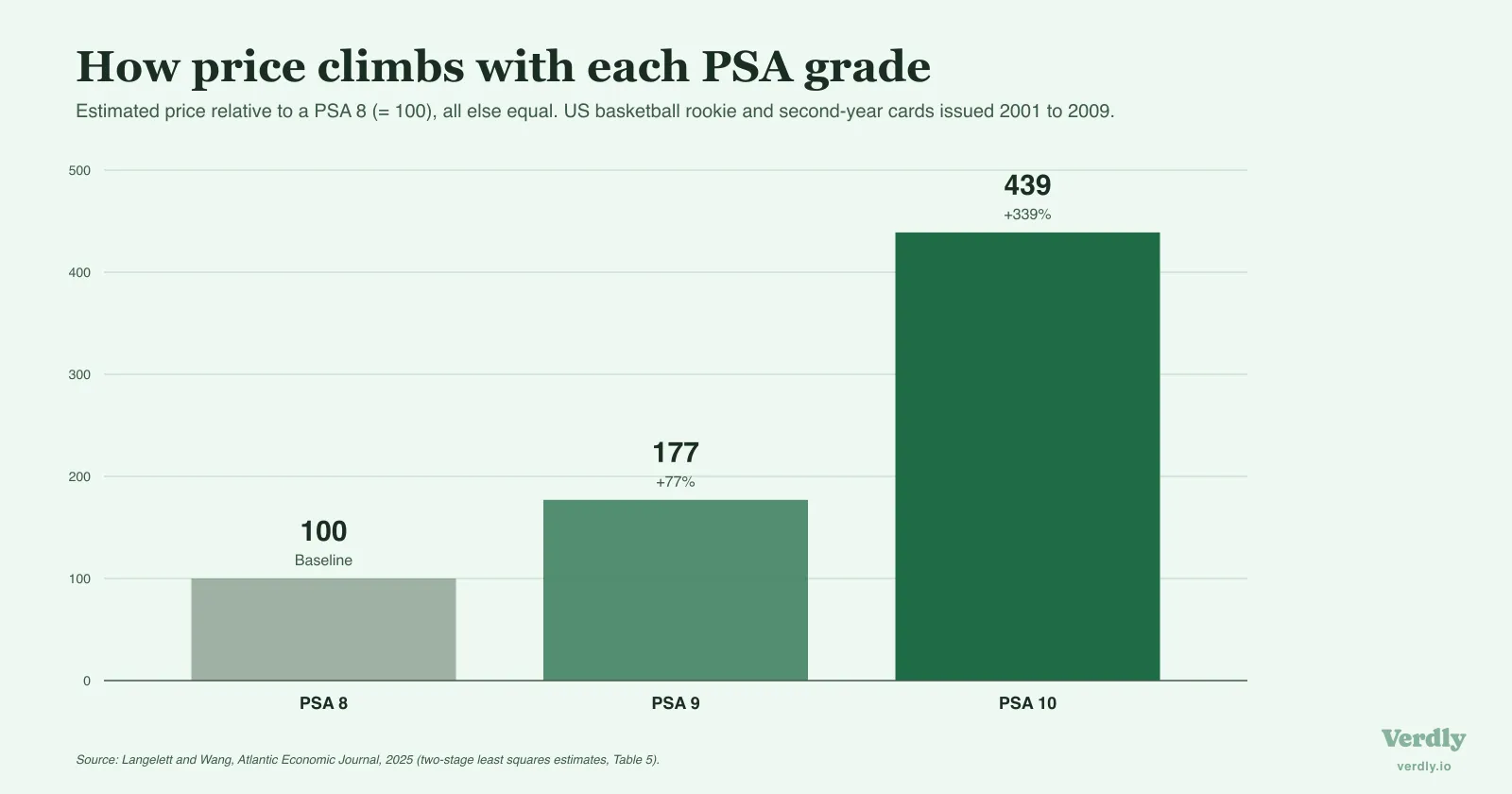
Read side by side, an 8 and a 9 are separated by a touch of wear. The price gaps are steep. A 2025 study in the Atlantic Economic Journal modelled eBay sold prices for PSA-graded US basketball rookie and second-year cards issued between 2001 and 2009. Holding everything else constant, it put a PSA 10 roughly 339% above a PSA 8, and a PSA 9 77% above it.
Grades don’t translate between companies either. In a field study of sports card grading, economists Ginger Zhe Jin, Andrew Kato and John List note that grades are “not readily comparable across graders”, and their estimates put a Beckett 9 between a PSA 9 and a PSA 10. Their data is from 2002 and 2003. A comparable sale has to match the card, the grade and the grader.
A raw card has a claim
A raw card is one nobody has graded. It has a range of grades it might get, and a condition that’s whatever the seller, or the owner, says it is. Jin and Kato tested that claim. Watching eBay baseball card auctions in 2001, they found buyers paying 33% to 51% more to sellers who claimed top condition, according to the working paper behind their study. They then bought ungraded cards from both kinds of seller and sent the lot for professional grading. Their paper in the RAND Journal of Economics found that some buyers “are misled by incredible claims of quality. They pay higher prices but do not receive better quality and, in fact, are defrauded more often.”
That’s one American study from 2001. A condition claim still costs a seller nothing to make, which is why “looks like a 10” in a listing describes a hope.
So a raw card can’t borrow a graded copy’s sales. The graded price is one possible outcome of a grading the card hasn’t had. Its value today is what raw copies in similar condition sell for, and the owner’s own reading of its corners is the shakiest input on the balance sheet.
Verdly publishes for education, not financial advice. Your circumstances will differ, so speak to a regulated adviser for decisions specific to you.
Where sold prices live
On a card that rarely trades, the date of a completed sale is as much part of the evidence as its price. eBay exposes its sold data in three ways.
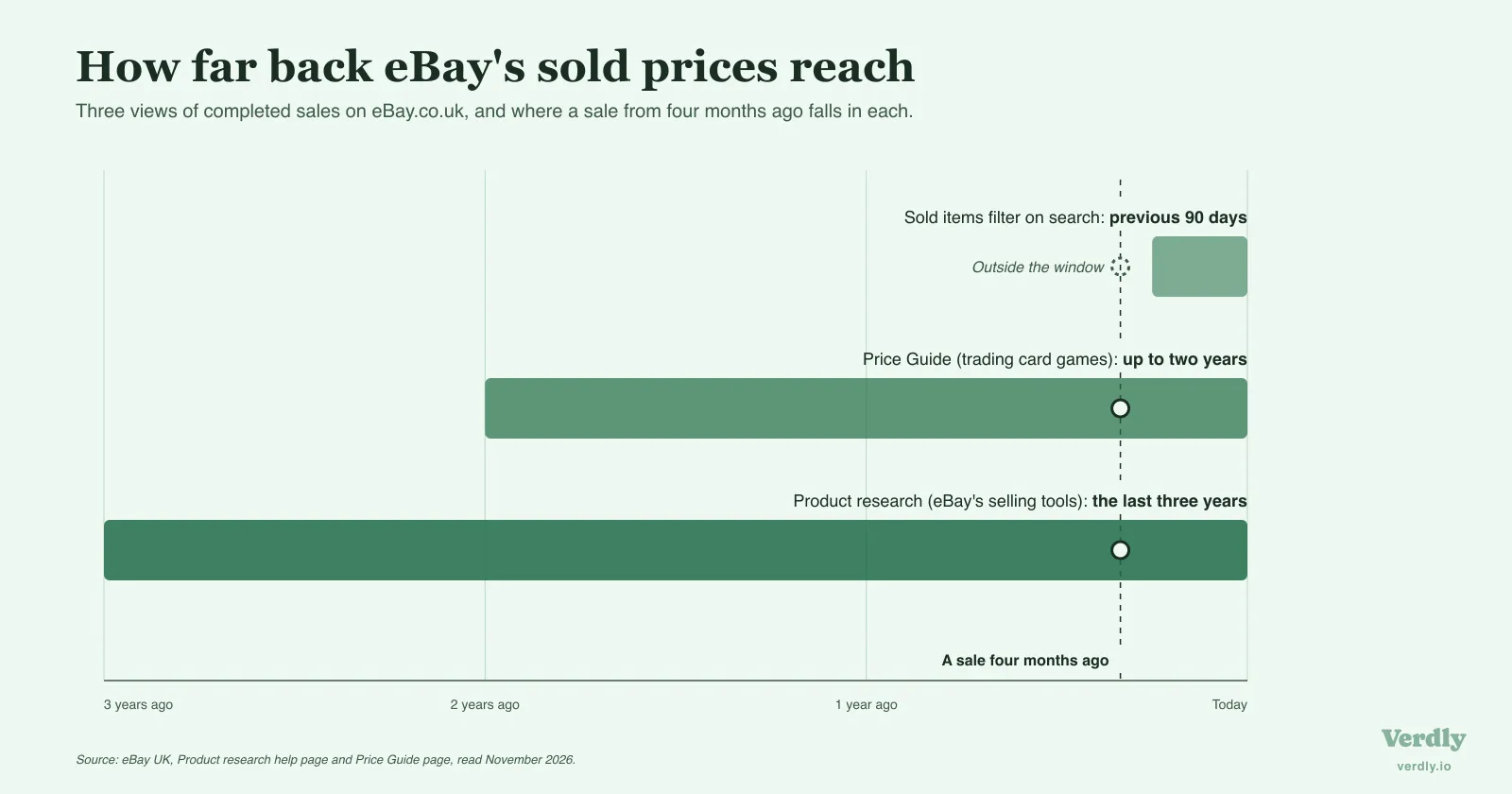
The 90-day and three-year windows are from eBay’s product research help page. A sale from four months ago drops out of an ordinary search, even if it was the only one at that grade all year.
The Price Guide, which eBay began rolling out in the UK from 1 September 2026, covers the most popular trading card games but not, so far, sports cards. It shows a median sold price, and where a card sold on a Best Offer, the median uses the accepted price rather than the listed one, so it’s built from what buyers paid. A median of raw sales can still mix a creased copy with a near-perfect one, so the sales behind it matter as much as the figure.
Thin markets
The higher the grade and the scarcer the card, the less often a matching copy sells. A grader’s population report, its count of the copies it has seen at each grade, is tempting here. CGC’s own population report says those counts are “not an indicator of value or rarity”. Demand only shows up in sales.
Take a hypothetical card graded 10 whose last matching sale was £400, fourteen months ago, while two 9s sold for £120 and £135 last month. Three common ways to handle it produce three different figures:
- Carry the last figure forward. The holding stays at £400, with a note that the evidence is fourteen months old.
- Widen to the neighbouring grade. The figure comes from the recent 9 sales, with a note that they’re a grade lower and understate a 10 by an amount these sales can’t reveal.
- Widen the window. Older sales of the 10 come in, with a note of how far back they reach.
Any of them is defensible once the note says which one produced the number. It’s the general point about how often each thing you own produces a new figure: a card in a thin market produces one only when a matching copy sells, so entering the same value period after period is normal.
Recording the evidence
Each card worth tracking gets its own holding, with the rest of the binder grouped as one line, which also keeps a collection inside the 100 open holdings an account allows.
For cards, the figure needs its evidence beside it. In a net worth tracker built around snapshots, that goes in the note on each snapshot: a line per card giving the grade, the grading company, the sale prices used and when each sale happened. The note belongs to the snapshot date rather than to the card, so for the hypothetical above it might read “Rookie card, graded 10: no 10 sold since September 2025 (£400). Valued from two 9s, £120 (12 October) and £135 (28 October).”
The Record screen shows each holding’s last value in grey beside its box but fills nothing in, so carrying a card’s figure forward is a deliberate entry.
One card can also matter for tax on its own. Gov.uk’s personal possessions guide says Capital Gains Tax can apply to a profit on a possession sold for £6,000 or more, and a single high-grade card can clear that. The £6,000 line for possessions covers how the gain is worked out.
The slab in the search results is a fact about someone else’s card. The note is the fact about yours: which sales matched, at which grade, from which grader, and when.